Patsy Casey

Patsy Casey took an Irish Mother’s interest in her 9 children and 38 grandchildren. Love. Pride. And devotion.

Like any Mother, Patsy enjoyed her children’s achievements, and worried about any set back. But always, always, Patsy was the foundation stone upon which the family thrived. The pillar of wisdom that provided encouragement, support and above all, unconditional love.

And everyone knew that. Her greeting when more than one child or grandchild arrived in Stella Maris said it all. “Well loves.”

Patsy attended family celebrations with great enjoyment, and a real sense of joie de vivre.

Whether that took her first class to Atlanta for first communions and high school graduations. . .

Or, to Celtic Park last year to watch six nephews win a Derry Senior Championship in gaelic football. A photograph of Patsy and the six boys victorious proudly adorns her living room.

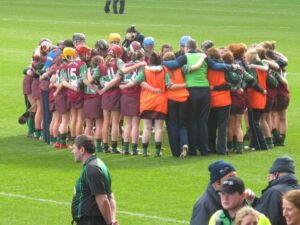
To Croke Park to watch her two granddaughters win an All Ireland in camogie last March, Patsy one of the first people to congratulate the girls on the steps of the Hogan Stand.

To christenings and confirmations in Derry and Portstewart, where her arrival was eagerly awaited as children clamoured around her. “Well weans,” she would declare, sometimes a little overwhelmed at the reception.

In good times and in facing the occasional challenge, Patsy was the inspiration and the consolation. The alpha and omega of the Casey family. A formidable woman.

For Patsy, just as important were the simpler celebrations of life. A summer’s day spent in Shroove swimming and relaxing. Walking Soda in Amelia Earhart. A visit to Daily Mass. Lunch with friends or family. Learning and talking as gaeilge. All part of the rich fabric of the life of Patsy.

To Leo’s annual golf tournament where friends and family gathered celebrating and enjoying wonderful memories with Patsy of her soulmate Leo. The craic and stories flowing into the small hours in happy remembrance of their times past in Sunbeam Terrace, the Collon and Stella Maris. And, of course of countless adventures over the years.

On the passing of her own mother Kitty, Patsy presided over a celebration of life in Stella Maris, when a young grandson was heard to tell a caller: “the party’s still on.” There was to be no excessive mourning or sadness on Patsy’s watch.

In recent years she enjoyed a short but wonderful reliving of her happy childhood, when her sister Peggy moved home, the two travelling hither and thither, enjoying the craic in a fugue of cigarette smoke and sisterly laughter. And she and Peggy enjoyed the visits of her brother Kevin and his wife Bridgin to Derry to their childhood home, Stella Maris.

Patsy’s telling of stories was wonderful, whether tales of Kitty and Pops, her father, or a reminiscence starting “Myself and Leo. . .”. the tales lost nothing in the telling. Kitty, Pops, Peggy and Leo all came to life for those that didn’t know them, and for those that did the memories came flooding back in glorious technicolour and gales of laughter.

For the immediate family and her circle of friends, Stella Maris with Patsy in situ was the centre of affairs. People constantly came and went, with Patsy in the middle of it all. But anyone who thought she didn’t know what was going on was wrong and very mistaken. For Patsy, family came first. Although Christmas Eve, Leo’s Anniversary was a painful time for her, she turned it into a family day and a celebration of his life. She loved Stella Maris choc a bloc with children and grandchildren.

There, you knew when she was home. Entering through the front door, the whiff of cigarette smoke, a lifetime’s pleasure and indulgence. Her beloved Soda greeting you at the door, that is if she wasn’t locked in the car, forgotten, until Patsy would remember suddenly, ‘God Soda’s still in the boot.’

Patsy lived her life with a strong Catholic faith that sustained her and gave her great strength especially in recent times. For her prayer was an essential part of daily life.

But Patsy was no soft touch and although sympathetic to others and supportive, she would prefix her occasional annoyance with the prefix “For God’s sake. . .”. Indeed some of the debates on a Friday evening among herself and her assembled friends were not for the faint hearted!

Patsy also had a wonderful sense of self-humour and would joyfully recount stories from over the years where she swam against the tide in the interests of getting things done. Whether during her teaching career or in the raising of the family. A generation of children taught can testify to the influence of Patsy Casey on their life. Likewise the countless other people that she touched in so many ways across the years.

But whatever she did or said, or whatever her latest idea was; her children would react with the same sense of self-humour that Patsy showed herself, and say:

“Gotta love her, that’s the Mammy.”

It is typical of Patsy that every single one of them will have a host of happy memories of her to draw upon and seek comfort and inspiration from in the weeks and years ahead.

Ár dheis De go raibh a h-anam.

Hey Joe

The morning after Derry won the All Ireland in 1993 I was on Radio Ulster to promote some event or another. Joe Brolly was on immediately before me.

Joe was still in celebratory mode and totally and utterly irrepressible. I’m sure the listeners of Ulster didn’t know what to make of him first thing on a Monday morning, live from Dublin, unslept, unkempt and on a roll. I groaned, I felt like I was going on air after the Beatles.

Of course, Joe has been all over the media for the last few days. In case you didn’t know, he donated one of his kidneys to a fellow coach from St Brigid’s GAA Club in Belfast. Shane Finnegan has had kidney problems for the best part of twenty years and has had a harsh regimen of dialysis and treatment. His only hope was a transplant from a living donor.

According to various reports, his clubmate Brolly sidled up to him having heard this news, and said more or less, I’ll give you one of mine. His link with Joe Brolly is merely that he coaches a club under-10 team with him, and their children play together. Having lost his cousin and transplant patient last year, Catherine Quinn, wife of former teammate Danny Quinn, Joe Brolly evidently felt he needed to do something to help and this was the obvious way to do so.

Paddy Heaney explained today how the impact of losing his cousin Catherine last year affected Brolly deeply, how he was moved to do something by the thought of children possibly losing a parent. It was the noblest of causes.

Often we see celebrities, sports stars and the like involved with charities as patrons. The idea is that in PR terms if a celeb endorses something it will bring more press coverage, make for a better photograph. There is no doubt that many of these individuals are motivated by a genuine concern for helping others. There are others who realise their personal brand portfolio is helped by being associated with a few worthy causes. Whether they truly support the cause, no-one knows.

In the case of Joe Brolly, actions speak louder than any words on a page or a television studio. He is no ordinary Joe. He’s known to most of us GAA fans as a handy former corner forward with a penchant for winding up opposition corner backs and their fans by blowing kisses after crucial scores.

The kidney Joe gave away last week survived a few hardy punches over the years from defenders hailing from Dublin, Cork, Down and Donegal, but the most bruising (and most definitely the most inconsequential) from despairing Tyrone corner backs.

Over the last number of years of course Joe is probably the pundit that most of Ireland loves to hate and love. Although he has winding up Kerrymen down to a fine art, if you pick through the outrage and annoyance, there is a lot of wisdom in what he says. Most of the time. Those that hate him are on a sticky wicket now.

This interest in helping others, it’s not a new thing. For a long time he has been an advocate for and supporter of Blood Transfusions. His interest goes back at least to his encounter with Brian Óg McKeever, a young 17 year old footballer from the Steelstown Club in Derry City who suffered from the Leukaemia that eventually claimed his life in November 2008.

The club is since renamed Steelstown Brian Ógs in memory of their former player who succumbed to his illness, but left a legacy of courage, hope, and honour in the face of unsurmountable odds. The name is borne with pride to this day by everyone who wears the blue and gold of CLG Bhriain Óg Bhaile Stíl.

The experience clearly left a mark on Joe Brolly. Writing about the loss of such a young talent Joe said:

“Eamonn Burns told me once that Brian was the only footballer he knew who had Tony Scullion’s anticipation. What a pity we will not see him in the red and white of Derry. What a pity that the world has been deprived of a boy like that. The Steelstown club has retired the number five jersey. They have also organised a Blood Drive on December 15th next at their clubhouse on the Ballyarnett Road. The City of Derry rugby team, Derry City Football Club and the Derry senior football squad will be there to give blood.”

[Source: Derry Journal, November 2008]

It is a thought-provoking piece that I commend to you.

When I first heard the news about Joe Brolly filter and flitter through on Twitter at the weekend, I thought it was a wind up. I soon realised it wasn’t. As the week goes on it is hard not to marvel at the total humanity of the man. It is a stunning, stunning act of kindness.

Joe has a reputation for being outspoken at times controversial. But underneath that, is a guy who has done nothing less than offer his club mate the gift of life.

It is a humbling tale.

The US Coach John Wooden wrote that character is what you are, reputation is merely what people think you are. If we didn’t already, we now know what Joe Brolly is.

The Man with the Hat, the Moustache and Three Greyhounds

Tenders. That old chestnut. I wonder have the people that write tenders ever actually completed one? If they had they might spare a thought for those of us that, from time to time, are required to ‘do them’ to try and earn a living.

I recently went for one and praise God was successful. Took me about four days equivalent in hours to complete it. I also worked on another for a client, they were unsuccessful falling at a minor administrative hurdle, not being able to tick a particular box. Another one I assisted with during the summer has yet to be awarded. We have run out of bated breath to wait with.

The inclusion of seemingly important but arbitrary criteria like ISO 2000 are a serious pain in the arse. Granted, their inclusion is an easy hurdle to place in the way of a would be supplier. To me ISO suggests that you are good at ticking boxes. It doesn’t necessarily mean you are a good manufacturer, printer, designer or whatever your expertise. Therein lies the rub.

Likewise a client recently was required to demonstrate their ability to provide business continuity in the event of a fire, flood or other act of God. The fact is that had there been any natural or man made disaster that impacted on production, they would have been able to continue their business by subcontracting. They just hadn’t written down how they would do, so busy were they actually getting on with doing what they do.

I must admit I am gamekeeper turned poacher. I used to devise these fiendishly clever criteria thinking I was the big guy. How the suppliers must have despised us. I faced down a supplier once, he was expressing legitimate concerns about not getting a face to face meeting. Our process was rock solid, tight and fair. This guy just wanted the opportunity to tell us he could do the job. His business later went bust. Not my fault, but I’m sure we didn’t help.

I accept people need these sorts of processes. It’s nice it you happen to win a few but often you don’t get that satisfaction. And as one client told me, these things are often written so the right person gets them. That’s true.

If its written for a guy with a hat, a moustache and three greyhounds, then it’s most likely that the guy who applies who has three greyhounds, a moustache and a hat will get it.

A Time for Everything, and a Time to Hurl

A time for everything. . .

This is a more recent article, I wrote it about a parent going out to watch their young lad start hurling.

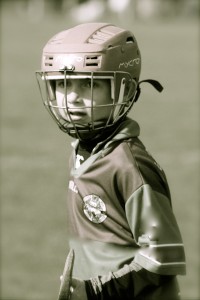
LIKE HIS FIRST steps and his first words, the first time your young fella hurls in a match, it’s something you’ll never forget.

Of all the places to be in our club, Under 8 hurling is where it’s at – it beats them all for the innocence, and the beauty of the fledgling game.

As one oul lad says, leaning over the wire, pipe in gob, hurl in hand: ‘you can see their DNA from the way they hurl when they’re wee.’ By the way he hurls the ball, by the way he carries himself; from a shrug of the shoulder, to a side step, to the young ciotóg who’s strong side is the wrong side. The genealogy’s plain to see.

It’ll start indoors maybe, hurling with a plastic bas that can do no damage worth talking about, although the odd skelp can sting a knee and concentrate the mind. The loose whaling as a cub hurler pulls with gay abandon – the shiny new helmet he got for his birthday makes him lose all fears. Like the superheroes on the television, he, himself, alone, sees a field around his body that fends off any invader. Invincible he is, invisible to foe, rock solid to his friends. He sees the ball. And nothing else. He’ll be neat and tidy when he grows a bit and he’ll hurl, no fear of that.

Times go by. . . when they learn to lift and strike, it’s as if a new world has opened and unfolds before them. Henry Shefflin in the back yard burying the ball time and again. . . bottom corner, top corner. Round the dog, past the trampoline, over the bar. Shanahan to Canning, bang. The neighbour’s window gets a rattle but thanks be to God for the new double glazing. The sliotar throws back in, a flying ground stroke scalds the backside of the cat as she runs for cover. The dog ambles off the field in the manner of the inneffectual junior corner forward who’s just been given the shepherd’s crook and called ashore. Happy he’s no longer in the line of fire.

Come Spring, come the big day. The biggest stage of all. The Blitz. First time hurling against another team. The new club shirt, clean in parts but the hint of the pre-match pasta stains the front.

It takes our lad a minute or two when the ball’s thrown in, the ferocious pull, the big tubby lad a few inches taller who bestrides the pitch like a seven year old collossus. His weight throws the others about like rag dolls. Our man gets a fierce belt on the knee, the tears well up as he goes down. Next ball a shove in the back and after that another clip as he tries to lift. The cat moved a lot easier than these boys and the garden was a safer place. He feels the burning in his eyes. ‘Come on our fella’ says the coach, ‘you gotta stand up for yourself, or do you wanna come off for a while?’

The eyes flamed a look, through the bars of the helmet. Defiant, determined, twas as if he’d been set free. Next ball. Next ball. Like his grandfather slicing in the bog, hurley down, he nicks the sliotar, neat as can be. One second the hand is there, the next the ball disappears and he’s away to the side. With a flick off the wrists he drives it down the field. The cheers of his mother unheard. Next ball. Tidy as you like. Another hops at his knee, he gathers and clears. You see it takes any man a minute to get into his game. And so it begins.

To everything its place and everything has its place. But when you’re Under 8 hurling, it’s the only place to be.

Another Martyr For The Cause

Distraught - this woman doesn't know what to do now she has lost her previously 'normal' husband to the GAA.

A married woman has contacted us concerned about her husband and recent changes in his behaviour.

With no-one else to talk to she was told to contact Talking Balls, her advisor or counsellor or whoever it was told her that we were highly knowledgeable, thoughtful and would give good practical advice laced with common sense.

The woman and her husband had recently moved to a new area for employment reasons. He had never displayed much interest in games gaelic and athletic before.

She, being a bit of a snob and having been brought up by a highly self-opinionated father, who considered the GAA to be the preserve of layabouts, gobshites, mucksavages and fellas who pursued a political agenda masquerading as sport, always found the GAA mildly distasteful.

Her own sense of opprobrium had been fuelled one day when she unwittingly gave a gaggle of GAA youngsters a lift home from school and they trailed muck and ordure into the rear of her spotless 4X4. The mark of studs and those awful blades could be clearly seen on the Camel coloured upholstery and needed more than a good valeting to remove.

Imagine her chagrin then, to learn that her husband had fallen in with a bad lot in his new job. These men were heavily, and she means heavily involved. They talked non-stop about hurling, football and even camogie, that dreadful game where big girls wore very short skirts and ran round a mucky field after a ball. It was the height of unladylike behaviour.

Over a period of months things took further and more turns for the worse. Her husband had started bringing their son to Gaelic and now the daughter had taken up camogie. She came home one day with a hole busted in the knee of her new skinny jeans from competing for a low ball. The boy had already put the knees out of a nice pair of those Canterbury trousers that the rugby boys wear so well.

Her husband had started heading off ‘up to the Pairc’ to watch all sorts of matches, senior football, hurling, underage camogie, seven a side blitzes. Before she knew it he had been co-opted onto the committee and was holding sub committee meetings in their kitchen and telling these big rough fellas with weather beaten faces, rough hands and ill fitting O’Neills gear that the ‘wife will make you a cup in your hand.’

Although rough looking there was something very civil about some of these men, not at al like the coarse creatures she had seen one day when she had followed the husband up to the Pairc to see what all the fuss was about. There they had been bellowing red faced at a young fella refereeing a game in a gusting gale.

The final straw had come when she caught husband sneaking out the door, himself clad in the O’Neills tracksuit and beanie hat. A row had ensued during which in a discussion about his forthcoming birthday and their wedding anniversary he had informed her that he would like a set of training cones for the former and wouldn’t be able to go out for a meal for the latter as it coincided with a championship match.

And her reason for contacting Talking Balls? Well it was to ask whether, as a friend had suggested, she go with the flow and submit to the inevitable or whether she issue her husband with an ultimatum. She realized that the latter would be futile as she might get the answer she didn’t want.

Another widow to the cause. Give her a year and she’ll be coaching fundamentals, making tea and sandwiches and bellowing at referees herself.

A Band of Brothers – This Was Their Year

Book Review

“There is a destiny that makes us brothers,

No one goes his way alone;

All that we send into the lives of others,

Comes back into our own.”

Edwin Markham

A few years back Christy O’Connor wrote his seminal book about hurling goalkeepers – Last Man Standing.

It was a fantastic read offering a real insight into the minds of inter county players. Their mentality, their preparation, their hopes, their fears.

I remember vividly the passage about the Limerick keeper being hit with a sliotar on the testicle which duly disintegrated on impact. The things that struck about the book was that these were ordinary guys, fellas we all knew and if we didn’t know them we knew someone like them. A brother. Friend. Clubmate. A son. Nephew

The life of an intercounty player is monastic. Those that do it properly live for the game. They eat properly. They cut out the drink and the social life. They need to have understanding partners, wives, girlfriends. And as they get older it gets hard if they have children.

When I first heard about Declan Bogue’s book This is Our Year it didn’t really capture my imagination. An intercounty player from each team talking about the year they had had? Didn’t sound like something I would be bursting a gut to read. The usual platitudes. I would maybe give it a quick peruse in Easons to see if it was worth the cover price. I should have known better.

My attitude to books is straightforward. Having read enough badly written rubbish in my life so far I’m not one for wasting time reading books that don’t appeal. Paddy Russell’s book sits on my shelf. Pretty much unread. Dara Ó Sé unfinished. Brian Cody’s. Underwhelming.

In any book and a sports book in particular the writing must be good. The avoidance of dry, repetitious match details and player banalities is a skill in itself.

Trying to capture the appeal of a particular sport which is familiar to many of us is a difficult task. Trying to strike the balance between factual information and recounting details of matches that the readership will have attended. It is difficult. Some can manage it.

So approaching the whole concept of This Is Our Year in a pretty lukewarm fashion, I didn’t really pay much attention when it was serialised in Gaelic Life, where author Declan Bogue is Editor. These boys won’t say anything interesting I thought to myself and busied with reading the Big Interview.

Until one Thursday morning, sitting at the kitchen table drinking a cup of tea I started idly to read an extract about Dick Clerkin. I had always considered Clerkin an abrasive boy. I had watched him joust with Dara Ó Sé over the years. True or not, word was Ó Sé agreed to play a Railway Cup match for Munster because it would mean he was up against Clerkin. Here was a fella I had watched in action in Celtic Park. In Croker. I had my mind pretty much made up about the sort of fella he was.

Until I read the extract where he talked about his mother and the impact some of the criticisms of him by Joe Brolly and others were having. It was compelling stuff. It had all the passion and intimacy of our games. I know mothers of intercounty players. The big intercounty midfielder standing up for himself that we all see, is still the wee lad that kicked ball in the back garden. That’s what his mother sees.

Immediately after launch I spent a day or two scouring around the bookstores looking for the book to buy it. By that stage some of what Kevin Cassidy was saying about the Donegal set up was coming out. About the savagery of training. About the professionalism. About his own sacrifice and dedication. It confirmed what I had thought when I read the Clerkin extracts. This was good stuff. Eventually I tracked the book down and bought it. And boy but I enjoyed reading it.

The thing about gaelic games in Ulster is that it is inherently local. We know these boys. Our clubs play against them. We see them at matches. We see them hang over the wire at underage matches at their clubs. We see them coaching.

And then, on the big days we see them in Championship. Most of us don’t see them do what it takes to get them to Clones on Ulster Final Day. The sacrifice. The uncertainty. The self doubt. The savage commitment. Their expectations of aspects of their set up. The disappointment when injury strikes. The excitement when new management meets expectations. The unspoken dissatisfaction when it doesn’t.

The brilliance of Declan Bogue’s book is that has managed to get a group of intercounty players to trust him with their thoughts. It is the honesty and insight that makes it compelling reading. At times if I were to quibble I would say I rushed past accounts of matches that I watched or was at but that is a necessary part of the structure. For others that will help.

The irony in the fall out from the Donegal camp following the book’s publication is that one of the Ulster counties – Cavan –  was represented by their management Val Andrews. Andrews has his own fair share of achievement and evidently saw no problem in taking part in a project that casts a searingly honest spotlight into the nooks and crannies of intercounty preparation. When I finished reading the Cassidy situation had snowballed and rolled out of control. The irony is he is nothing but complimentary about Jim McGuinness and his regime.

Others are less restrained. Paddy Cunningham is forthright and critical of the Antrim set up. I was surprised having read it that there was not comeback from the Antrim management. Maybe there will be but as with Alex Ferguson and Roy Keane’s comments, if there is a problem in the camp, fix it. Don’t talk about it or seek to nail the guy who has the balls to say we could do better.

Likewise, the most shocking passage in the book is not from one of the nine protagonists. Rather Ross Carr, father of one delivers an ultra critical attack on the Down management in defence of his son. He rails against Aidan’s lack of game time with Down. As a former manager I would have thought he would have been more restrained or circumspect but again, it is to the credit of the book and its author that he has managed to capture these passions. There it is, ugly or not. Like it or not.

The narrative structure is excellent as it successfully interweaves the stories through one another in much the same way Christy O’Conner did in Last Man Standing. It is written at times as third party observer of the player in his own natural environment. The fly on the wall offers a great insight into Cassidy’s kicking preparation at home at Magheragallon – a dedication to his craft that ultimately brought Donegal back into the game against Tyrone and earned a quarter final victory against Kildare.

Likewise the description of the day in Ballinascreen when Skinner Bradley damaged his knee. Bitingly honest. Accurate too. The players I have spoken to that were there have confirmed every word of even the smallest detail even before I ever read Bogue’s account.

In other places the main players recount in their own words. The fact that not all were top of the bill in the Championship adds to the interest.

Mickey Conlan of Derry troubled with injury, sacrificing everything to make the team including changing jobs, a decision which I think he would admit has benefitted him greatly. Barry Owens, brilliant player in a bruised and broken Fermanagh set up. My admiration there is greater than ever.

Ricey is perhaps the most reserved of the subjects. Cassidy has been well documented and harshly treated in my view. Aidan Carr’s story is one of a plane that never really took off. Val Andrews is insightful. Stevie McDonnell refreshingly honest. Paddy Cunningham may have a few extra sprints to do come pre season!

And last but not least Dick Clerkin. It was his account that brought me to the book. Since he has started writing for The Examiner. What Clerkin’s story tells us, if we didn’t need reminding, is that these boys are amateurs who are professional in everything else they do. So that the rest of us can chat about football the whole summer through. But, if something does go wrong, as it did for Dick, he still has a mother and a family to go home to. We would do well not to forget that.

Declan Bogue captures that. All of it. The essence of what it is to be a gaelic footballer in Ulster. Just because they are familiar doesn’t mean we know them. But after reading this, you will have a better idea of what it takes to get them to Clones on any given Sunday every summer. And that is what makes this tale of this particular band of brothers such a compelling read. Buy it. You won’t be disappointed.

The Returning Old School Hurler

The Old School Hurler. Age never wearies him, he hurls every day as if it's his last.

This article first appeared in the All Ireland Hurling Final programme.

The tale of the Returning Old School Hurler, like the story of the man who’d been abducted by aliens only to come back to earth, is a tale worth telling.

In a club far away from the heartland of the Déise and the Cats lives our man. A Legend perhaps. The Returning Old School Hurler may have emigrated, succumbed to a fragrant or, more likely, nagging wife, or over-depended on the drink. Now he’s returned, pressed backed into service, reluctantly, with a gnawing in the pit of his now-larger-gut.

Our man, as someone that could ‘hurl a bit’ is asked to put his shoulder to the wheel one last time, to help a posse of precocious young Turks find their own feet at senior level. His role? To pull hard, early and often; to show example; to demonstrate his guile and to dispense restorative justice to liberty-takers, if required of course. The latter achieved with as much subtlety and aplomb as the deft flicks by which he lifts and clears the ball from a melee of players on the edge of his own square.

In his day Lucozade was something brought to hospital; on a coul day a t-shirt worn under your jersey – not one of these skintight affairs that looked like something guys would wear to a nightclub called the Pink Paradiso. The balls too seemed lighter these days – in the mists of time poccing a water-logged sliotar over the bar late on to seal victory was a valuable life-skill, requiring wrists of iron and the swing of Thor to heft the hurley. And what of the hurley itself?

He returns to his mother’s garage to retrieve his sticks – linseed oiled and sprung, long, and elegant, with narrow grips of bare ash, sweeping down in curves sweetly-grained to a supremely crafted bas with honed blade. When he pulled them from his bag, the dressing room fell to silence, staring in wonder – bananas temporarily unchewed and Energise undrank. Our man pondering the unexpected interest, but saying nothing – as usual. Short shorts, too tight for comfort, a badge-faded battle-worn jersey – barely legible: County Final 1989.

On the field he raised a greying eyebrow – the young Turks’ hurls like malnourished saplings beside his own – colourfully gripped but armlength short it seemed to him. Not for the Returning Old School Hurler – his hands dipped in rosin, sliotar seized from the air with the speed of a cobra strike. The 37″ hurley? He could hook a man across the road twas that long, but could he wield it? Oh yes. In style. With panache. In any situation.

Gradually the younger players knew – they were in the presence of a higher being. When he trained, they watched. When he played, they played. And when he finally spoke, they listened.

Old School. Twas as if he’d never been away you know.

The Journey is the Reward

The Calm Before.

It was the spring of hope, it was the winter of despair, we had everything before us. . .”

Eoghan Rua camogie won the All Ireland Intermediate Club Championship in March 2011, repeating the achievement in 2012. Those days in Croke Park were unforgettable for the players. The Chinese have a saying, the journey is the reward. It is a sentiment I can relate to.

The 2010/2011 Ulster and All Ireland campaign followed our first ever Derry senior championship success. Having defeated a good Clonduff side in the Ulster Final we were preparing for an All Ireland semi final against the Munster Champions. It was uncharted territory for us. Lavey had been down that road before providing inspiration and a reference point that we could be successful, even though the gradings at All Ireland level had changed.

My own involvement started a number of years earlier. How times have changed. I recall going in to one session at St Joe’s . The players stood in static lines of three pucking a few well-worn sliotars back and forth. There was no intensity worth talking about. A number of the same players are still involved. That level of operation wouldn’t be acceptable or tolerated by them now. They came a long way and matured as players, as individuals and as a group. Anyhow, back to Autumn 2010.

We were notified by the Camogie association that the All Ireland Final had been secured for Croke Park but that this would mean that rather than playing the competition off prior to Christmas with a final in later November at a county ground somewhere, the semi finals would be played in February. The Final would follow in Croke Park in March.

To be honest I personally groaned and grinned at the news. The former because it raised a whole new expanse of uncharted territory; the latter because in my wildest dreams I never for a moment thought I would be involved with any team in Croke Park other than as a supporter. I had watched an old teammate from school Noel Donnelly steer our alma mater Omagh CBS to a Hogan Cup title. I roared at him from the premier level that day and he replied with a thumbs up. In time a conversation with Noel was to be one of the most important pieces of advice I received about taking a team in Croke Park.

Having won Ulster we were embarking on a serious adventure. The team had limited experience playing outside Ulster, various players had county experience, some had played inter provincial and a few of them had won the Gael Linn. Others had experience at University level and others had played in Ulster College All Star teams. In 2009 we had entered a team in Kilmacud sevens and performed creditably.

Preparations continued, and by continued I mean the intensity of training was significantly stepped up preparing for Ulster, and then the All Ireland campaigns. My own view was that we had to incrementally increase the pressure for the higher-level competition we would encounter. It had to be incremental, and in fact the players often didn’t notice the greater intensity work, or if they did they didn’t complain (that much). At times sessions became brutal. I recall sitting next to a lad from Ballinderry at the County football final and he was telling me about work Mike McGurn had done with their senior footballers. It immediately gave me ideas. Over that winter I did a course with Ulster GAA that gave me plenty of food for thought. I also attended a couple of other events that enabled me to bring new fresh ideas to training in addition to material I drew up myself based on my perception of how and where we needed to improve as a team.

This Croke Park carrot meant a number of things in practice. Firstly although it was late October, we had to stand down our entire training programme. It was not possible to keep a squad in training for two months with no further games until February. The team would have gone stale and collapsed inwards on itself. Keeping the thing fresh was key. That then raised the issue, having taken the team off the boil completely, how could we get them back to the required standard. It posed plenty of challenges, not least for the players. Essentially we were asking them to maintain a high level of personal fitness over an eight-week period with no collective training.

In trying to plan for this I spoke to a number of coaches, including people within the club but more importantly and specifically St Gall’s manager Lenny Harbinson and Paddy Tally then Down coach. Both freely gave me advice on their own experience and offered a few pointers on the way in which to manage the situation and the players’ expectations. I owe both men a debt of gratitude and took great pleasure in contacting them after our first success to thank them for their sound advice.

In particular I would mention Paddy Tally because after our championship exit in 2009 to Lavey I wrote down all that was wrong with training, my own coaching and the group of players. It made difficult, challenging and uncomfortable reading for me personally, but it made it crystal clear that things had to change, starting with myself.

I had to find a way to re energise my own contribution, in the hope and ultimately in the confidence that it would help the players. In late 2009 Paddy gave me some simple pointers, showed me some of what he was doing and importantly why he was doing it. That meeting opened a new window on coaching for me. That and a session taken by Eamon O’Shea in early 2011 in Dunloy showed me what was possible with a little imagination added to the mix.

The suggestions Paddy and Lenny gave me helped me straighten out my own thinking and simplify things that were worrying me. As a consequence for example having initially been of the view that players involved with University squads should not play with them, I did an about turn and agreed that they should continue their commitments. These were after all competitive games and although there was a risk of injury the pros of a happy contented player outweighed the cons. Méabh McGoldrick, our captain was also captain of Jordanstown and to have been overly prescriptive would have resulted in an unhappy player. Méabh played away with Jordanstown and managed her joint commitments admirably. A light hand was the correct way to proceed there.

Without going into the details, for both winter campaigns, we congregated in December. We worked to a pre planned schedule of sessions I had designed to get the players back to fitness through a fairly brutal but condensed programme followed by a three week championship set up working on specific areas of play. The latter included matches, some of more value than others.

The players were required to train and play matches during the Christmas holiday, the quid pro quo being that I organised sessions in a way that the players could go out on St Stephen’s night, New Year’s Eve etc. I don’t believe in a drinks ban when you have a committed group of players and ours were highly committed during these two specific campaigns.

In addition to the normal season’s training the winter sessions involved in the region of 50 training sessions between December and February, a further 12 -1 5 between the semi finals and finals; video work, travelling to watch the potential opposition in marathon all day trips to Cork, Kilkenny, Westmeath, Laois and Tipperary. For each of those Brendan McLernon drove hundreds of miles at his own expense. The craic was good and we established a sort of standard routine. Brendan’s antics scouting the opposition team were priceless. He would eavesdrop on team talks; size up players during post match celebrations dictating notes into the ubiquitous machine. These scouting trips were the bedrock of success in 2011 and 2012. Yes it was a total pain in the arse leaving home at 6:30am to drive to Buttevant or Durrow but the notes, tape and observation were beyond price. You get a sense of what you are dealing with observing another squad in action. It is hard to describe but it was an essential part of the method.

For every training session over the winter we provided food and water for our players. For the first campaign that was dealt with from within our own resources i.e. team management. For the second year the club organised a rota amongst members to ensure that every session was provided for in terms of food. This was particularly important because we had a number of players travelling from Belfast, often leaving work to come straight to training on a Tuesday and Friday. We started sessions a bit later to accommodate the travellers but that meant in turn they were later on the road back to Belfast.

That winter the weather was particularly horrendous with terrible snow. It is to our credit we only had to cancel one session. Twice I had the players on the beach in temperatures hovering around minus ten. On Boxing Day we trained on a small patch of sand as steam came off the nearby sea. The players were put through a savage running programme with limited recovery. One passed out in the cold, another tore a hamstring from inadequate warm up. Thermal tops and leggings were compulsory. It was savage stuff. One day heading to Dunloy for an indoor session another player badly damaged her car skidding on ice.

During the second campaign one player came to me and pleaded to go home after a 40-minute session in torrential rain and wind at the University. Under the floodlights, the windmill spun in the darkness, we couldn’t see it but we could hear the sound, as the floodlight illuminated the 45-degree sleet and rain and the waterlogged field. The water was lying on the pitch as players completed a stamina running figure of eight routine with little ballwork. The twelve or so players that came out that night will not forget it. Others either couldn’t make it from Belfast or assumed the session wouldn’t be on. They should have known better.

Not having lights ourselves at our club pitch, we had to train in other locations midweek. During the 2011 winter we used the lights at Coleraine rugby club twice a week. We were immensely grateful for their cooperation even if it was a costly exercise. There were some in the club ranks that raised an eyebrow at both the venue and the costs but we needed somewhere to train. My view on this and other matters was that I was prepared to do whatever it took, and wherever the task took me to ensure the players had every chance of success in their campaigns.

In 2012 we used the new lights at the University of Ulster which meant we were able to train on a proper Gaelic pitch for all of our sessions. This was a significant bonus and not to be underestimated. There are times since that I have gone in there, and looked round, the place deserted. It was our laboratory, the teams tactics and strategies were forged in that place night after night. It was in there that we worked on the elements that ultimately won us the match against Ardrahan.

In terms of financial costs, the first year our campaign involved overnight stays in Dublin twice (the first day our semi final was postponed due to a waterlogged pitch). For the replay the game was at the last moment on the Thursday fixed for Cloughjordan in Tipperary. Whatever chance of travelling to Dublin on the day of the match, this required an overnight stay. This time in Birr. The three overnighters cost in the region of £3000 each for accommodation, coach and food and other expenses.

On these overnight stays we got our routine in place. Mass if we could get it that evening rather than in the morning; dinner, team meeting and then players could do as they pleased. Some went for a swim, some went to the physio. It was kept as relaxed as possible. My abiding memory is that once we got on that big Yellow Chambers Bus, the squad was together, the players were happy in the company of their teammates. The routine was similar, the atmosphere relaxed and the craic good.

Looking back there were some magical moments along the way, and as someone said to me today, it is only when something is gone that you realise how much you miss it.

“In the midst of winter I finally learned that there was within me an invincible summer.”

The Journey was the reward.

The Tale of the Apple Nano, the Guesthouse Owner and the Taxi Driver

In conversation the other evening with the proprietor of a local Guesthouse we were talking about the different levels of expectation amongst visitors of different nationality. Talk about differentiation…!

One notable difference my friend commented upon was that visitors from the United States tended to have very large items of luggage which they unloaded en masse from the car and brought into the B&B. They seemed to have packed for every eventuality he commented. His role? To lug the luggage up to the rooms. In return he sometimes received a tip. Even staying for only one night, every item of baggage is brought into the house and up the stairs. He duly obliges every time, knowing what to expect.

It reminded me of a tale told to me by a taxi driver in Belfast who was doing the Airport run. He complained bitterly about ‘Some Big Yank’ who after being picked up at the airport and driven to the Europa Hotel, expected the taxi driver to then lift his baggage out of the Cab and into the hotel. That being what would happen back home in the US of A and most right thinking places.

But no. Not with this Taxi Driver, the Travis Bickle of Belfast. He of course refused to carry the bag, and complained bitterly that he didn’t receive a tip for the job of driving him. “Lazy big fuckin Yank expected me to lift his bag in so he did… then he didn’t even give me a tip.”

I listened amused – he didn’t realise that by actually carrying the bag he may have received a tip beyond his wildest dreams. Touché.

The customer service culture is one with which we are not entirely comfortable to be honest in this country. There are those companies that do it very well. Some indulge the customer to the point of being overbearing. But, it can be hit and miss.

For others, it is so good it comes across as their natural state and they don’t even appear to be trying. I suppose the acid test is when it comes down to customer complaints. In your business, how do you deal with them?

In Christmas 2010 during the bad weather, I ordered an engraved iPod Nano direct from Apple for my son from Santa Claus. It was ordered more than two weeks ahead of the big day and I was confident Apple wouldn’t let me down. Then of course the bad weather struck with the news full of tales of orders not being fulfilled.

Sure enough Christmas approached and no sign of it. My son aged eight, and still being a believer couldn’t be told that Apple had sent the Nano but Santa hadn’t picked it up on time. No, despite the recessionary times, we took the collective decision to buy a Nano in HMV. I have recently developed the simple approach ‘if you can’t control it, don’t worry about it’ .

I resolved to worry about Apple after Christmas. I assumed the Nano may arrive at some stage. So I range early in the New Year to explain the situation and spoke to a guy from Cork on the helpdesk. I told him I had bought another and was disappointed the original handn’t arrived. I was prepared for an argument to secure a refund.

After running though my details, card number etc, “OK” says the Apply guy. “We’ll refund that OK?”. “What” I spluttered. Gobsmacked. I couldn’t believe it, I hadn’t even asked the question!

It is one of the golden rules of customer service to exceed customer expectations. If you let them down, the relationship has already drifted towards negative equity. Arguing the toss over something when you are already on to a loser isn’t necessarily the best policy.

By taking the wind completely out of my sails, the Apple customer relationship operative (or whatever his official title is) not only exceeded expectations but succeeded in another detail. As a result of his helpfulness and the fact he executed a no quibble policy faultlessly.

He also achieved something else. Since then I have been telling people how good Apple are at customer service. Isn’t that what we all dream of? Word of mouth marketing.

iPerfect.

Postscript: I called into the apple store in Belfast. One of the Geniuses working there approached me. Can I help you he asked. Yes, I replied, can you fit some extra memory for my macBook, I have it here. Yes I can he said, but it will cost you about £150. He edged  closer and said conspiritorially, my advice is to go online, buy it yourself It’ll cost you about twenty quid, and fit it yourself.

So: iDid, it did, and iDid. iPressive.

I Wrote it Down Here Somewhere

Can you explain in writing your business does? Really? Can you describe it in say, thirty words? If you met a stranger in an elevator and she asked you what you do, could you tell her before the doors re-opened?

One of the problems that I come across in dealing with all sorts of organisations –  small-businesses in particular – is the inability to describe in writing what they do. They know their business inside out, they eat, breathe and live it so what’s the problem?

You’ve seen it yourself. Someone decides that you need a brochure/website/Facebook page etc. A budget will be allocated to graphic design to make the thing look the perfect but little thought is given to the words. And yet words are something we use every day to describe what we do.

A few years ago I came across the writing of John Simmons. At the time I was sort of casually hunting about looking for something to give me fresh ideas on writing copy for business. I had worked in a University where the management and the administrators wrote deadening, stultifying prose that was teeming with ‘best practice’, ‘deliverables’, ‘cutting edges’. . . the whole effect of course was to create a ‘centre of excellence’. (Aren’t they everywhere?) The effect was to emasculate language, to cut off its you-know-whats.

I knew that this sort of tripe most definitely wouldn’t do when writing for other people. Although I could write with the best of them, I could feel myself gradually getting mired in this nonsense. I had to make a deliberate and conscious effort to shake it off.

The problem I still find when I work with businesses is that some to stray into corporate-speak. It is easier to talk in jargon than say anything meaningful. That is a trap you must avoid. To help, there are many sources out there on writing for business.

But many books of the books on writing copy seem to be written more in the form of self help books by American copywriting gurus, full of big bold headlines like ‘How to ensure your email is opened’ or ‘Twelve ways to write a sales letter.’ All good stuff I’m sure, but I personally didn’t feel the immediate need for a writing recovery programme.

So when I discovered John Simmons work almost by accident, it was a breath of fresh air. I think the first book I read was The Invisible Grail. The opening sentence reads:

‘The basic narrative of this book is the quest for the ‘grail’ that will enable brands to build better relationships with their audiences.’

Hmmm I thought, interesting but not rocket science. As I read on however I became more and more enthused. John Simmons advocated an entirely new way of writing for businesses. Creative. Engaging. Using humour. Poetry. Taking inspiration directly from great works. He says:

‘Words are a creative force: words that write poems, tell jokes, engage people in conversations. Words that tell stories.’

This last sentence in particular intrigued me. Telling stories. Reading The Invisible Grail, I quickly moved onto his other works, We, Me, Them and It and Dark Angels. These books tell the story of how you can write well for any purpose without lapsing into corporate-speak. But more interestingly how to bring your work alive by being daring, adventurous and using the influences that are all around you. Anyone who is interested in improving their writing should read them. Now.

His latest work is excellent, highly enjoyable and very stimulating: ‘Twenty-six ways of looking at a blackberry: How to let writing release the creativity of your brand

If you have the chance and the time, try reading John Simmons. You’ll find at least 26 ways to improve your writing.

In the meantime don’t settle for dead prose that turns your customers off. Tell the stories, have a joke or two. Engage them by talking directly to them.

You never know what might happen.