August

It is August. Aside from the calendar I know from the colour of grey that inhabits an August sky.

Also, the chill wind that senses where exactly it can get in to a house, and announces its arrival with a whistle-hiss.


That lying imposter, the unreliable sun that you want to believe will shine but never does when you need it.

That wind again, listen.

A body would think it is winter. And noone could blame you all the same.

It’s a melancholy month. Too many memorials, anniversaries. Though I have vivid recall of happy times.

Of a storm, thunder, and lightning striking, sitting in my granny’s living room in Omagh. Huge lumps of hail sousing the verandah splashing on the bounceback and rebound.

Now at the memory of that, and other August storms and tempests, it’s my time to well up.

On the Shelf. Are You?

Shelflife

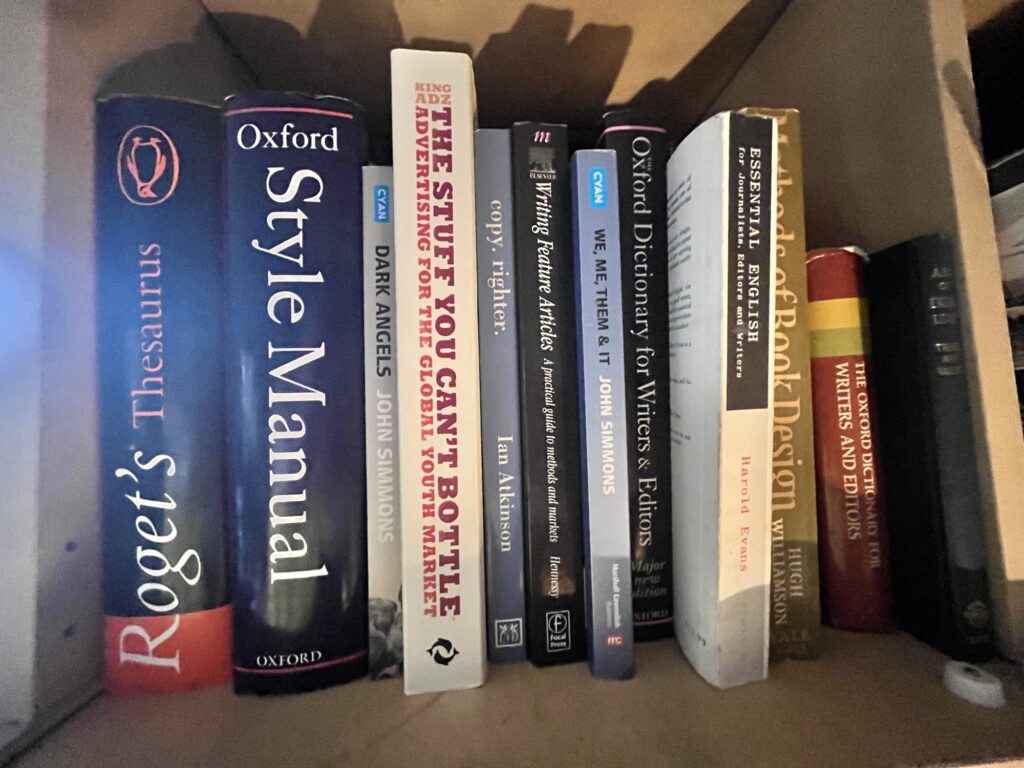
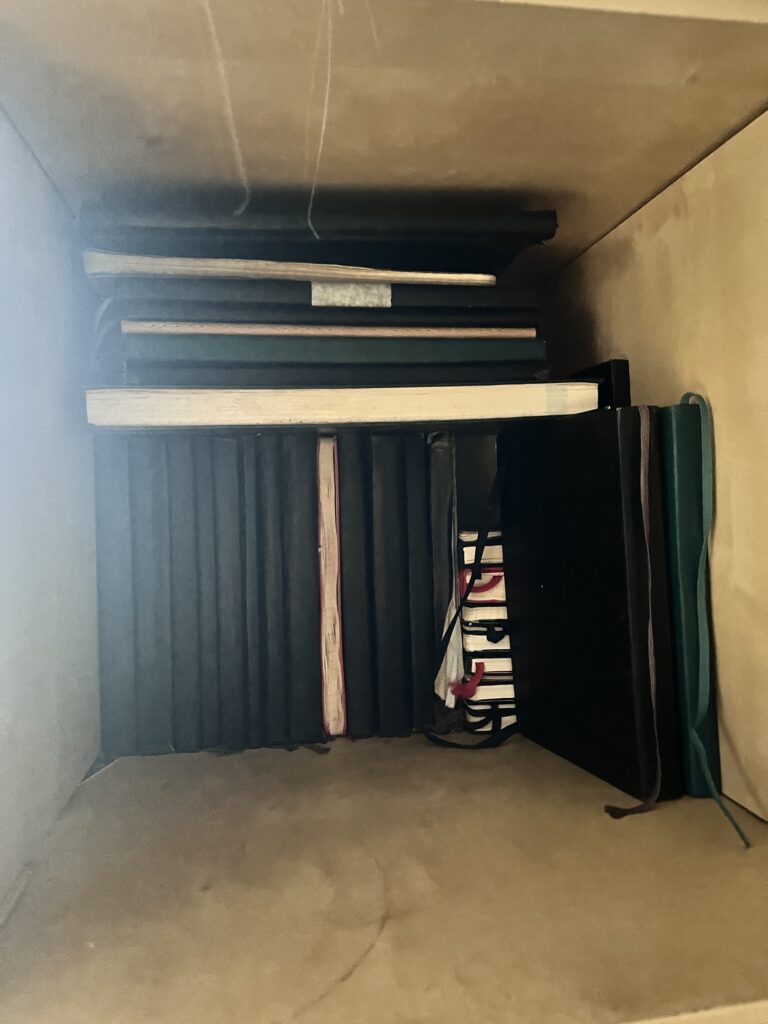
A shelf of reference books for work. There are others. Behind on the same shelf are 16+ years of notebooks with handwritten ideas, scribbles, steals, scripts, things that went nowhere, and others that worked.

Not for general reading, hence the positioning, most people wouldn’t understand what is written anyway.

Nonsense, gibberish, genius, jokes, facts, fiction, stories told, others untold: diary notes, observations, research, prompts, meeting notes. Someday someone may delve in or more likely at some stage they’ll be incinerated and ‘brent to brondeȝ and askez’. Torched, ignited, smouldering reduced to white ash in the fire pit that will blow away quietly with no fuss.

Books of Evidence and Nonsense

The other books are tools for writing, editing, proofing, shaping, for being precise and correct. Not in a starched knickers governess sense, but in the sense that if you choose a language, you should use it properly. Anybody do that anymore? Anyone?

There are many ‘content’ creators now, where did they come from. Self appointed experts, how many actually apply any rigour to what they produce? They don’t teach this stuff in CAM by the way. Holding a pen or wielding an Apple Pencil doesn’t mean you can write.

If you are working with copy written by others, what is your reference point for style, grammar, correct usage, and spelling? (Do you know the havoc that US spelling can spread, assisted and abetted by the likes of MS Word?).

On a shelf somewhere to keep you right is there a Roget, a Chicago Handbook, Harte’s rules, an MHRA handbook or another friend indeed?

It is a skill working with others’ work and your own. Have you the competency and confidence to face down a thick sheaf of A4 pages? Or the savoir-faire to take a page design, count the words per bloc and then write 50 words where only 50 is needed or 15 where 15 is required? Where ten words need to become seven? What about it?

Universities don’t teach this skill either, bar a few exceptions. You are expected to know how to write – a dangerous assumption. Once you graduate, you are set free into the world to write reports, business plans, proposals, product descriptions, and minutes of meetings. The results? Often gibberish.

AI will subtly make it worse because text editors will do the job for you, but they don’t know everything despite the hype.

When you’re shaving a word here and there, sculpting, shaping the text equivalent of base metal into, at best, fools gold, turd polishing, where do you turn?

What of the tyranny of the blank page? How are you on that front? They need a copy, and they need it quickly. What’s your next move?

What about production? Do you understand the process? What’s your Acrobat game like? Do you know your PDFs from your IDF? Can you strip out the text? What about diacritical marks? Garbled text?

Designers mask many woes, usually under a deadline and the last link in the chain they have to apply copy and imagery to their page design quickly.

There’s more to all of this and more than meets the eye. For now I can’t go on. This is what attempting to organise shelf does. Still, I can’t go on.

DeskLife

What is all that stuff on your desk I have been asked.

Desk Life

My reply. It all has a place and a purpose. If not for others, for me.

Let us go in then, an inventory of sorts. 

One screen good, two screens better. I would gladly have more given the opportunity. Twice the space and sprawl. I have been jealously stalking a mammoth curved Samsung screen for no good reason to be honest. But I could work approaching not 24/7 (god forbid) but 360 degrees. For the eagle eyed and there aren’t many these times, the screen desktop on the right is a photograph of a sensational sunset. A large print of the same shot I took reposes on the living room wall. 

How do you increase your desk area has no one asked ever. But if we only answered questions where would we be. So I answer regardless. Opinion. Fact. Theory. Whatever, it works for me. I haven’t actually measured the extra space provided by my mezzanine desk innovation but the difference is noticeable.

 By repurposing a couple of mesh in trays & magazine racks I was very pleased with myself. Miscellaneous usb hubs, chargers, ink jars and diverse objects can stay on the desk, close at hand but out of sight. What of your in-tray you may ask. Well, all I ever really did was let it pile up until crisis point whereupon I threw it all in the bin. Now I just throw it in the bin straight away. Out with the inbox and into the outbox. I have places I stuff things. That works for me but I can’t always find the things stuffed.

There are three lights on my desk, two useful and one ornamental. One of the useful ones is in use here, the ornamental one is on but of no real use, while the third and therefore second useful one is off, and out of sight. But it is there even though it is off and emitting no light. All IKEA. Airplants I have several. One in the 1/3 pint milk bottle was bought in a posh garden centre where they sell ludicrously expensive garden pottery, statues, gazebi and other follies. (I like gazebi rather than gazeboes). The other airplant lives in a reused Glendalough gin bottle, that I constructed myself, although sadly I did not deconstruct the gin myself. The green glass beads come from an ornament in our home in Omagh. Typical Christina nic nacs.

There in their small green case, Rosary beads given to me when we met Pope Francis the first time in Rome. Also there is a sleeping St Joseph, a strong man of silence (no not me). I let him sleep on anything that is bothering me. The Pope asked me to pray for him. I do.

Phone/iPad/tablet stands are there – for utility rather than ornament. Some people want to look at me when they talk to me. Why for the love of God I do not know. I find it difficult to look at myself betimes and used to tell myself that when I toiled at that University. ‘Look at the shape of you I would chide.’ Then I would look at the state of some of the  Professors I had to deal with and was reassured.

Capo. This is a rather expensive Thalia capo I splashed out on during lockdown. A clunky bit of indulgent guitar bling and typically American. Well-crafted and substantial, but the best capos I have are Shubb. I have several depending on the instrument of torture on any given day.

Desk life, roaming wild. Wooden hippo, I Giorni. Fantastical Glass animals from Rome.

Fountain pens, Parker. Black, blue and roasted red ink. I only really use these pens or a pencil in my work notebooks. As the channel through which my thoughts make it into the real world, or at least the world I inhabit, it is only fair that the instrument should be elegant and the notebook deserves no less. Sometimes a pen can be blocked, scratchy, devoid of ink, or can overflow and flood a page. Just like its owner. 

Item. Mac keyboard with annoying sticky a key. I had it replaced but it’s still not a hundred per cent.

Notebooks, one for work, I have a couple of shelves full of material I should revisit. Another for music, chords, theory, progressions, words, songs made suddenly clear. Also a journal for writing therapy. Therein I document the passage of grief, anxieties, insecurities and observations. I lament and keen and weep for things and people passed. Writing something down is therapeutic. Even pointless pieces like this piece have purpose. Peace. Settles an unquiet mind. I recommend it. If people like it, well that’s their choice.

That book there  about the early church in Ireland I will read with interest. I came upon it looking for another. Ireland’s landscape is punctuated with monastic dwellings, holy wells, a landscape of faith rich in story and alive. 

There I see an LP coffee coaster Cáit got me for Christmas a while back. Also there my ruler. Most people have rulers that go to 30cm but mine goes to…31cm. One centimetre can make all the difference. The man smiling benignly from the photo and observing every move I make is my dad. Younger when he died. 

Than I am now. The cross on the wall is a penal cross made from turf by the sadly defunct Owen Crafts. We brought one to Peru on our honeymoon and presented it to a family we stayed with on Isla Taquile. I remember the nodding, smiling total lack of understanding in the Quechua speaking woman and her husband as I talked about Lough Derg. I don’t imagine they ever made it over.

Thonder a Tibetan singing bowl. It’s deep tone is strangely calm and healing. It amused my mother greatly. 

The desk itself cost 18 quid from IKEA when I was getting myself started. It’s wobbly, chipped and cheap. I should consider another but it has served its purpose well.

And what of these trinkets. Essentially they mean nothing and when I’m done could all be swept into a bin bag and dumped. But they are familiar, calm, reassuring. For me.

And what of this piece? An exercise in writing about nothing that I set myself today as part of trying. Job done. Nothing ventured.

Turn Up, Tune in, COP Out

Serendipity brought me to Glasgow last weekend, not in my capacity as eco-warrior and general life guru, but en route to Islay for fresh air, a break from things, and some single malt whisky.

Passing through Glasgow, it was apparent that everyone had jumped on the COP26 bandwagon; whether it was wind power, solar or just hot air wasn’t clear. Billboards, posters, everywhere seemed eager to make some climate-related point.

The wallpaper effect is in full view, everyone trying to say something and ultimately communicating nothing. The virtue signalling was all around. It’s been a long time since I was in Glasgow, and the immediate impression on my return was the traffic – there were cars everywhere. Of course, the first thing needs to go are cars, but that won’t happen.

There is no doubt that trying to unravel the diverse contributors to and causes of Carbon emissions is complex, intractable and tied up in many vested interests. Nevertheless, you have to admire the innocence of teenage mutant ninja eco-warriors reusing their shopping bags, switching on their gloomy energy-saving lightbulbs and staring mournfully at the empty fire grate with four jumpers on to stay warm, berating politicians and other carbon wasters through chattering teeth.

Until the mega polluters of the world change their ways, the situation is unlikely to change. Chinese manufacturing will continue so long as the rest of the world wants to buy the things they make, likewise in the US and Russia where oil = big bucks and influence.

Crying Wolf

In Ireland, which contributes less than 1% of carbon emissions, 80% of electricity from renewable sources by 2030 is the target. But, despite Ireland’s progressive role in adopting wind farms, is it realistic?

Leading the charge is the Green Party led by Eamon Ryan, who cycles from the front. Someone who has a career interest in bicycles that the Third Policeman would be envious of is determined to recycle the entire country. He recently declared the end of fossil fuels, and all new cars will be electronic by 2030, he says. Fair enough. This is the same person that wanted to reintroduce the wolf to the Irish countryside, almost 250 years after the species became extinct in Ireland.  Mr Ryan said he believed that wolves should have a place in Ireland’s environment and would contribute positively to the ecosystem and the State’s national habitat. He also annoyed more than the Healy Raes of this planet when he  suggested that a village of 300 people could operate on 30 cars. Car sharing, cycling down to your pick up point would be straightforward; indeed you might get there quicker if one of the wolves decided to give chase.

Ireland’s island status, clinging to the west of Europe makes it ideal for wind farms. And indeed harnessing wave power if it can be made viable. Last year despite the growth of the windfarm estate approximately 11% of energy was lost because of problems with the national grid. In other words one in ten windmills is a waste of time. There are diverse views on windmills.

Ireland’s Birnam Wood

sCommunities point to their size, scale, closeness to property, visual pollution as negatives. They use large amounts of concrete and their end of life disposal plans aren’t clear. Alarmingly also the construction of wind farms has caused MacBeth-esque slippage of forest and bogland. Most recently tonnes of peat slipped downhill near Meenbog Wind Farm, close to Ballybofey and the Co Tyrone border,

The wind farm is owned by Invis Energy who said helpfully: “There is no risk to public health.” The Environmental disaster caused the pollution of the internationally important salmon spawning Mourne Beg river. But hey, who cares about the death of a few thousand fish and their contribution to biodiversity, fishing and tourism.

It’s happened before. In Galway in  2003, during the construction of a 70 turbine wind farm in on the Slieve Aughty mountains at Derrybrien. The landslide sent tonnes of peatland, trees and debris down the mountainside, killing tens of thousands of fish and disrupting natural ecosystems. Repeated attempts to stop the slide by erecting earthworks were effortlessly swept aside by the moving landmass.

In 2019, the Irish State was fined €5 million in relation to the site, with further penalties of €15,000 per day, until the government assesses the impact of the development. To date, the Irish state has accrued over €15 million worth of fines in relation to the wind farm. That continues, so add that to your energy bill. These bogs are also huge carbon sinks and movement or disruption causes the release of carbon, defeating the entire purpose of the exercise. If you want to cycle up and take a look, or take your wolf for a walk, be my guest.

Military Precision Emissions

There’s more. Not many people know that Military figures are not included in a country’s carbon emissions tallies. This is quite unbelievable when you consider that the US military is estimated to emit more hothouse gas than 148 countries out of 195 in the world. Shame on them you may say, but consider for a moment Russia, China, North Korea and India about whose emissions we know nothing.

To give an idea of the scale of the problem, while the eco children of woke Northern Europe are tootling about in their electric cars and bikes berating politicians, Norway invested in a squadron of F-35 fighter jets. These yokes burn 5,600 litres of fossil fuels for every hour they spend in flight.  The average car can travel 61,500 km for that amount of fossil fuel, in other words, a car would take three years to throw out an hour’s worth of fighter pollution.

In 2017, the US military bought c270,000 barrels of oil a day and emitted more than 25,000 kilotonnes of carbon dioxide by burning those fuels. The US Air Force purchased US$4.9 billion worth of fuel, and the navy US$2.8 billion, followed by the army at US$947m and the Marines at US$36m. In comparison, the carbon footprint of EU military expenditure in 2019 was estimated to be approximately 24.8 million tCO2e. This is equivalent to the annual CO2 emissions of about 14 million average cars. It is also considered a conservative estimate.

Taking the Climate Emergency Seriously

It’s no wonder that one of the first things the Northern Ireland Assembly did after their three years off due to the RHI and subsequent huffing debacle, was to declare a Climate Emergency. There is no doubt that if someone lights a turf fire on the Malone Road or  desperate housewife fires up the Aga in North Down that there will be repercussions worldwide.

Some countries take the whole situation more seriously than others. Spare a thought for the Zimbabwe delegation to COP 26, that comprised 100 people. Sixty of them have no expertise in climate issues. To get his team there the Zimbabwe PM hired a private jet from Azerbaijan at a cost of $1million. The lads on the trip were clearly pleased to get the gig and entered into the spirit as social media images emerged of delegates pushing groaning shopping trolleys laden with Glenfiddich, Jamesons and various other treats including Irn Bru. The climate briefing obviously covered the need for a hangover cure on a cold Glasgow morning.

It hasn’t been reported whether or not any tiresome teen eco warriors joined the Zimbabweans jollies, it may be that it would all be just too much fun for these eco eager beavers. And anyway as far as they’re concerned you can shove the whole thing up your arse.

What’s the answer? Some folk reckon that it’s hard to establish any actual starting baseline from which to measure progress because there are so many variables world-wide. While  the west pursues the ‘fossil fuels bad, renewables good’ maxim, there are other subtle and nuanced views. We could do with some demilitarisation for a start. Make peace not fighter jets. Avoid virtue signalling and empty words and pathetic suggestions. Bicycles may be a solution for an urban woke elite but they won’t cut it elsewhere. Government ministers lecturing us all whilst complicit in eco disasters in their own back garden aren’t acceptable. Likewise the teen ninja eco-warriors. All the hot air and headlines without any accountability.

Developing World Differing Perspectives

Some chastening words on COP26 from NJ Ayuk JD, MBA, Executive Chairman at African Energy Chamber

“I respect China and Russia who aren’t attending #COP26. They’ve no intention of playing games and will drive up their energy industry while the West impoverishes their citizens through radical action. Ironically not attending is better for the planet than the hypocrites arriving by private jets and burning a few million litres of rocket fuel through the atmosphere every 5 minutes to show off to their friends and lecturing Africans to go green immediately with failed promises around energy poverty. China and Russia are laughing at you.

“The 400 private jets used by world ‘leaders’ to get to #COP26 pumped out 13,000 tonnes of CO2 into the atmosphere, yet they want you to stop eating meat, to stop going on holiday, to buy a new electric car when we don’t even have electricity to charge a Tesla (600 million Africans have no lights), and to spend thousands of dollars on new boilers.”

Jocelyne Machevo, from Mozambique, Energy Industry Expert

“Mozambique is a resourceful country, besides many things we have discovered a huge amount of gas that placed us amongst the most prospective regions in the world. As one can certainly understand, the gas industry also acts as a catalyst for further developments and industrialization, so we (Mozambicans) see in these discoveries an opportunity to boost our socio-economic development.
In Mozambique, less than 50% of its population has access to modern and reliable electricity. So we also see in these discoveries an opportunity to leverage on our own resources, using this gas, which happens to be relatively cleaner, to improve access to energy to the Mozambican households and serve as the base load required to boost industrialization. In simple terms, this is our plan as Mozambicans.

“Data has shown that Africa’s CO2 contribution is minimal while the developed world was busy maximizing the benefits of their own resources and focused on their own development, which is nothing but fair and understandable. It is now our turn to do the same, to exercise our fairness right.
We have decided to not romanticize and entertain solutions that will not solve our core problems. Renewables at this moment, cannot solve our energy poverty issues, we do not have yet the money, matured technology, infrastructure, policies, just to mention a few.”

The Solution?

I suspect I’m not the only one, and that other people are fed up with the likes of Barack Obama, Joe Biden, Mary Robinson, Elon Musk, Eamon Ryan and worst of all Boris Johnson telling us what to do. With their cavalcades, their executive jet, their space rockets, hot air, self-interest, cycle schemes, wind farms, and huge military expenditure the answer is straightforward. Turn up, tune in, and COP out.


Do Your Home Work and Get the Job Done

Home working Guru

Home working. Remote working. Hybrid working. Virtual office. Many terms are being bandied about on the merits and negatives of working somewhere that is not ‘work’. My workplaces have included lay-bys, Portstewart beach, a pub near Loch Ness, various coffee shops on the North Coast, the garden, my bed, hospital, St Peter’s Basilica and the Colca Canyon in Peru.

Years ago, when I was being interviewed for an employer that operated across multiple sites, I was asked in the interview how I would manage working across long distances. I replied that I had just worked on a book with a writer that lived in South Africa, so I didn’t see the difference between the north coast and Belfast as much of a problem. That was before email, the days of fax and putting items in the internal mail.

Funny how some people think writing memos all day telling people what to do, justifying what they have done or exercising their personal desire for a bit of office-onanism. These are the same people that think lengthy meetings are ‘work’ and productive. They aren’t.

Now it wouldn’t be best practice to give away the trade secrets of the brotherhood and sisterhood of home workers. But there are a few pointers, and as Jane Eyre might have said, Dear Reader, you can make up your own mind which is true.

Most people assume that working at home involves a fair bit of dossing. Certainly, aside from the givens like wearing whatever you want, or nothing if the mood takes you, there isn’t the same pressure to look busy or appear absorbed in your work as in a ‘normal’ workplace.

Suspicious Minds

Employers have a natural suspicion of workers ‘working from home’. So as I heard an IT Guru explain earlier, often you may have had to be in your role for two years before you get the go-ahead to work from home. Having been there for the arbitrary time of two years clearly delineates a worker that is dedicated to the cause. Think about it. What nonsense. That thinking will no longer be acceptable in this post-post-industrial society or whatever it is we live in.

As an aside here, companies generally aren’t judged as profitable based on the number of hours an individual spends inside its four walls are they? There is an assumption that time on the premises is related to productivity. When you break this down, the logic of people coming together to work was a product of the industrial revolution and manufacturing technology growth. The calculation is simple. More people operating more machines generated more product.

So success was based on an equation of something like ‘No of employees x Hours worked = Output (profit)’.

So as an employer you want the maximum number of people on-site to operate the maximum amount of equipment possible for as long as possible. Think about the domino effect on all aspects of the worker experience, enjoyment, quality of life.

So success was based on an equation of something like ‘No of employees x Hours worked = Output (profit)’. That’s fine if you’re producing something tangible like a widget, a shirt or a component etc. The equation can be further refined by burnishing the employee factor by adding things like training, skills, being nice to them. The ‘hours worked’ factor can be adjusted by paying staff to work longer hours (overtime), or by making the equipment they use more efficient. There is the option too, of course of shift work. Demand will dictate that half your work force at any time are working at night. And they’d better get used to it.

Of course the optimum for many employers is having efficient equipment and having employees prepared to work for longer hours for no extra financial reward. There is a reward of sorts, of course, in that if you are always seen to be working late or starting early, then assumptions are made about your dedication and commitment. Sending that 3.30am email solving a problem or completing some task is a way of showing your undying commitment to the cause.

Absence Makes the Cart go Under

Except it’s not. One of the problems in the workplace is that of absenteeism—the crime of not being there when you’re supposed to be. I always thought this was a fallacy because I worked with many people, and with quite a number of them, it really made no difference if they were physically present or not. Both in terms of their own efficiency and productivity, and in the positively detrimental effect they had on the people around them. This can apply equally to management, and the saying when the cat was away, the mouse can play is true. Let the frivolity begin. Equally true is the reality that if the cat is away, the mice can get on with their work in a state of uninterrupted euphoria that the boss won’t be lurking about, checking on them and generating additional meaningless and pointless tasks.

I worked with a manager who worked late one evening a week minimum, dictating memorandums to all and sundry. That was his work. To me, that is not work. Yes, he was there physically, but it was a pointless enough task. So my judgement was that it was a waste of time being there and suggests a further waste of time during the working day to necessitate after-hours presenteeism.

Yes, then the other side of the coin is presenteeism, the opposite of absenteeism. In this situation, the worker can get themselves into such a state of workplace ecstasy and frenzy that they spend multiple extra hours at work and then bring the work home, plug in their device and go again. This individual is to be pitied, looked at askance and sent for help. They will buy TV dinners for the microwave, drink excessive amounts of coffee and volubly tell everyone how busy they are, how tired they are. They won’t admit that they are in fact, inefficient in their use of time, possibly incompetent.

If as a worker it is your misfortune to be managed (often micromanaged) by one of these people, then you will likely be expected to devote yourself to the Gods of Presence, and tension is inevitable if you don’t conform. The trick, in this case, is to be efficient in what you do, get the tasks done and preserve the artifice of being a slave to your work and your workplace.

Otherwise simple landmarks like completing a task during the working day and getting ready to head home at the appointed time will generate muttering.

I will return to this new method of working from a location that is not work in due course, but in the meantime, here are some tips on home working based on working on many assignments.

Ten Tips HR Won’t Give You About Home Working

1 Invest in a sofa. Hard to beat a sleep during the day as the need arises. More comfortable than slumping and drooling over your desktop let me confirm.

2 Try and identify a time to be at your work station, whether it be desk, kitchen table etc. Once you get there it may take a while to get into work mode and you may get lost down a rabbit hole or two, but you are there.

3 Keep a list of what you’re trying to do and don’t be afraid to switch from one assignment to the other for short blocs of time.

4 Have a notebook and pen to write down your stream of consciousness, ideas, notes, frustrations. If an idea doesn’t work in one place, you may be able to produce it as a solution somewhere else.

5 Get a good selection of tunes and a decent sound system so as necessary you can turn up the volume.

6 Don’t watch daytime TV or use daylight working hours to catch up on your box set (not even just one episode….?) NO!.

7 Live and work guilt free. Want to go for a walk? Do it. Need to go to the bank? Go do it. Couldn’t be arsed working this morning. Then don’t work. Want to work tonight instead? Do it. Find the times that you work well and slot yourself in there. Employers need to understand we’re not all morning people.

9 Invest in a fish tank. Very relaxing.

10 Play your musical instrument for a while every day at your desk.

Rather than be a slave to the clock, remember you’re not a factory worker or a sweatshop worker. Apply different rules for yourself. Your own rules. Based on what you produce. Not on time spent. And stick to them. And have a few plan Bs and Cs. Not every day is the same, and as Heraclitus said, you can’t step in the same river twice.


Fair Warning Lord will Strike That Poor Boy Down

With the passing of Eddie Van Halen I’ve had a sad excuse to listen back through my Van Halen collection. Probably goes without saying, for any Van Halen fans,  their first album is the benchmark. I always liked VH I and II, but for me the albums that are the most memorable are Women and Children First and Fair Warning. The reason?

When I was doing my A-levels I applied to do English at Kings College and University College London. This required me to attend for interview so off I went to be interviewed by a couple of scrufty old profs and a rather stern-looking but attractive woman in a not-quite Ann Bancroft way. She who gazed at me over a pair of horn-rimmed glasses, nodding sagely at my answers. The old duffer beside her in jumper and tweed stroked his beard thoughtfully.

I wasn’t sure what her intentions were. The nadir of the whole experience was when she asked me for a comparison of Edmund in King Lear and Iago in Othello. My response? I replied, “to be honest I haven’t really thought about it too much.” That was my considered opinion on two of the great Machiavellian villains of Shakespearean literature. I knew then that my chances of joining the elite in London had disappeared. The woman looked mildly disappointed, it was as if she’d set me up for an open goal and I fell over trying to kick the ball. All was lost. Even namedropping that my mother was a first cousin of the brilliant Irish playwright Brian Friel, as she had instructed me to do, didn’t get me out of jail. It was a close shave. I could’ve spent the rest of my life gazing into the abyss of my own academic arsehole in London. Instead, I ended up in the fleshy parts of the holy land. What dear reader you may think has this got to do with Eddie Van Halen?

Well during my visit I took a stroll to the Virgin megastore and spied there two Van Halen albums that you couldn’t get hold of back in Omagh. Women and Children First and Fair Warning. I arrived home full of glee more excited about my new listening material, fairly unconcerned about the blown opportunities in London. I consoled myself safe in the knowledge that the stern older lady often mentioned me at fancy cocktail parties in Bloomsbury or Highgate or wherever the academic class gather. “That Irish fellow… I wonder where he is now? I’m sure he could’ve been someone,” she probably mused wistfully.

Meanwhile back in Omagh I was seduced by the divebombing and tapping of EVH as he kicked off Fair Warning with Mean Street [https://youtu.be/U2R2KXNQR1M]. The album is probably Van Halen’s heaviest effort. The guitar playing is supreme, I Alex Van Halen’s drum sound was immense,  t combination the brown sound as they called.

Standout tracks are the aforementioned Mean Street, Hear About it Later (Isolated Guitar track: https://youtu.be/7Zy1D0uH1ys] and So This is Love, the drum intro on the latter a thing of beauty. Alex Van Halen is on tiptop form and alongside them Dave Lee Roth jackasses around on vocals, entertaining as usual. Dirty Movies is a funky enough outing, with a classic Roth interlude “Take it off, take it all off.” Funny, dunno if he’d get away with it now, or if he’d care! For me Unchained, is one of the classic EVH riffs, chopped guitar with staggered drum beat a bit like Bonham [https://youtu.be/Cn8APTMyKsg]. Sunday Afternoon in the Park is weird, something you’d play loudly on repeat to annoy the neighbours. Push Comes To Shove has a reggae like bass intro and a leery guitar line to go with a sleazy vocal from DLR.

When I heard from Brogy that Eddie Van Halen had died Fair Warning was the first album I stuck on [for some reason we used to refer to it as Fair Warning Fair Warning I don’t know why].

“…And someone said fair warning, Lord will strike that poor boy down”

If I could meet the lady professor in London now I would ask her for a comparison of Women and Children First and Fair Warning and see how that one goes down at a fancy Bloomsbury cocktail party or wherever. Eddie Van Halen, RIP. Ar dheis Dé go raibh a anam.


Travelling Lockdown Bar Blooze

“There is no greater sorrow than to recall a happy time when miserable.”
Dante Alighieri

Pubs. My mother grew up in one and I’ve personally funded several establishments over the years, freely giving my time and money to ensure their ongoing prosperity. But.

I don’t get out or go out much anymore. Nothing to do with lockdown, no. It’s more to do with getting older, disinterest, and the problems of getting locked on a night out and the unplanned adventures that can ensue.

The people you meet, bump into, folks you see after all these years, or the local plumber you’ve been trying to get a hold of to fix the toilet. On any given night out, that’s all part of the craic. On a weekend in Dungloe last year some of my longtime beer drinking comrades attempted to relive parts of their misspent youth jousting with a few locals from Kincasslagh who behaved poorly in a chip shop. We had to intervene to diffuse an impending melee. In the course of the gung-ho diplomacy one of the younger nightowls told me that he respected old people like me. If he’d hit me a punch in the mouth he couldn’t have stopped me quicker in my tracks. It was funny. And reality.

The vintners in Ireland are desperate to get the pubs up and running and have proposed a series of measures, or half measures, to get things motoring again. Now, frankly the ideas floated propose a vision of going to a bar that I don’t recognise. It’s the pub Jim, but not as we know it.

The new sanitised, hellish and unfortunately necessary vision of a trip to the local is so squeaky clean that a night out with Stepford Wives would be more fun. It sounds like being forced to socialise with people you don’t know times ten. You know like when you end up accidentally part of a girls night out and you scour the bar for a sidekick. You won’t even be able to do that.

Six people only to a table. Everyone must stay seated. Organised visits to the bog. Table service only. Remind you of anything? School dinners. No DJ or live music. Too bad, by the way, about the gig economy. Musicians who are the lifeblood of pubs; the two piece with a chickaboom drum machine; the somber-faced, utterly miserable looking traditional musicians in a corner belting out their sets (they definitely won’t be smiling now); the one man storm-in-a-tee-shirt-Christy-wannabe; the Argyle-jumper-clad accordion player with the long suffering wife dressed in housecoat accompanying gamely on banjo, bodhran and backing vocals, quaffing pints of Smithwicks.

“Please be seated over there. Six to a table. A waitress will be over shortly to give you the Covid Safety announcement. Please do not leave your seats.

When she arrives, haggard from a career in Aer Lingus, the automaton waitress’s instructions are clear, dreary and tired. Borne of necessity.

“The queue to the bathroom is to your left. No more than three occupants at any one time in the Gents. Please observe social distancing by using every second urinal and we ask in particular that you exercise due care when shaking the last few droplets, as you know droplets can spread disease.

“There will be no communal eating or sharing of crisps or nuts at your table. Each patron is requested to purchase and consume their own snacks.

“Customers should not fraternise, flirt with or glad eye any patron at another table. Once assigned a table you must not swap tables to get closer to a nearby acquaintance. Attempts to do this by subterfuge will be resisted. Closed circuit TV surveillance is in place at all times.”

“You are not permitted to go to the bar; all orders will be administered by waiting personnel in a manner befitting social distancing. This requirement will be strictly enforced. All high stools have been removed.

“Any patron displaying signs of intoxication will experience the form of social isolation known as being thrown out and barred. Signs of intoxication will include loud argumentative talking resulting in the release of spittle; such slabbering will be frowned upon because of the droplets. Likewise outbursts of loud solo singing in the absence of proper music is forbidden, many people release droplets when they sing. Sean Nos singing is also strictly prohibited, nothing to do with Coronavirus.”

“Smoking in the smoking area has been decommissioned and patrons are asked not to smoke in the environs as WHO advice suggests compromised lungs may increase your chances of infection.”

It is a vision of hell at the bottom of a glass. Public houses will become rooms where groups just sit and drink. I went into a mining community pub in East Falkirk once that was like that. Linoleum floor, formica tables. It was fucking grim then. The Scots were protesting poll tax and the Miners strike had been and gone, the men sat at these tables, heads bowed, not talking. Drinking.

If you can’t stand at the bar, sit at it or go to it, remove the bar itself to a backroom and make more room for the drinking stations. Bring back snugs, with their service through a hatch, locks on the inside and opportunities for couples to court or priests to drink furtively after mass. Anyone who’s ever been in the Crown in Belfast has experienced a snug session. Cramped and good craic, social isolation it is not.

Some of the most interesting people you will ever meet, you meet at the bar. Conversation and loquaciousness suitably lubricated, the at-the-bar banter is witty and charming and at times irresistible. At other times your bar encounter can be a pure pollute. “would you like a drink?” “No I’m in a round (code leave me alone).”  To a hapless female standing waiting, who ends up with too much head on her beer, the witty interjections, “would you like a flake in that. Do you come here often?” Tactlessness award goes to the man who unwittingly in the old Queen’s Speakeasy asked the girl with one arm to help him carry his round down from the bar.

Standing at a counter I’ve met Pat Cash, Jimeoin, Andy Irvine from Planxty skulling brandy, and Gerry Adams who I told not to take my seat as it was against party policy. Many others. The Bomber Liston, George Best, Pat Spillane, Pat Crerard, Norm from Cheers. It isn’t on the cards anymore, no not for the immediate future. And it can’t be.

The concern is that in trying to keep the industry afloat, Vintners will distil the pub experience from a pint into a shot glass, sanitised. If there’s no atmosphere, no experience there’ll be no people there. Other than the people who are there to drink and drink only.

For now all these seem a distant memory of times past. For the future we need some thinking outside the box, so its not just all about getting locked and out of your box.

The hardcore drinker at the bar traditionally practises social distance easily with a growl and a grunt so no one comes near. The bartender knows by eyebrow lift and subtle hand movement that more porter in required. The reverse nod indicates another half ‘un.

How do I know? A lifetime in bars, I used to sit as a cub beside the daytime drinkers in my uncle’s bar in Omagh. Dipping a finger in the bitter drip tray, a taste of what was to come. Even at the age of five the bar stool was my throne, my platform and my high chair.


Home Work #3 – Triggered in Tesco, Social Distancing in Sainsbury. Lockdown Looms Large.

Standing in a queue outside Tesco the masked stranger in front casually broke wind loudly and forcefully, not a whiff of an apology. Thank the Lord for social distancing in this instance. But since when has it become socially acceptable to Bris Gaoth in this manner in a public arena? When he wasn’t looking inside the store, I deliberately sprayed the hand disinfectant in the direction of his derriere.

The giant extra terrestrial bodypart threatening mankind.

That we are living in unusual times is stating the obvious. This week astronomers revealed that a mile wide haemorrhoid will pass within 3.9 miles of the earth. Well that’s what I heard half sleeping listening on Alexa. When I interrogated Alexa further, it transpired that it was in fact an asteroid and it will be 3.9 million miles, not piles. I had calculated half asleep, that it would be closer to our house than Portrush and was puzzled at the scientists’ apparent complacency. Surely such a large heavenly body would pose a severe risk to mankind? Then I saw an image of the item and it indeed looked like a heavenly body of a different sort. My mind was put at ease.

So. In other news, the Pentagon just casually put it out there that the US Airforce had video footage of three Unidentified Flying Objects. Sure enough the scarcely believable news was backed up by the evidence. But if someone had asked you three months ago which of the following is more likely:

1          The president of America will suggest people inject themselves with disinfectant or

2          The Pentagon will publish detailed images of UFOs.

Which would you have gone for?

There is no point dwelling on Trump because any ridiculing of his antics dates so quickly, as he surpasses his own stupidity daily. It is a sad reflection of American politics that the best counterpoint that anyone can find to Trump is Hillary Rodham Clinton and now Joe Biden. People like Mario Cuomo have something about them in terms of gravitas, a presidential air and some sort of stature about them. Al Pacino would play Cuomo well in the movie of the Covid19 Disaster Movie.

Picture Joe Passmore

Social Isolation

When we look back on these strange times, what will we see? A mere Pangolin or Bat responsible for a change in the way of the world. Airlines grounded, football suspended, pubs and chapels closed. Hand sanitiser everywhere.

Whenever the next generation ask what did you do during the Great Lockdown of 2020 the answer will in large part be ‘Not Much.’ I had contemplated keeping a diary for posterity sake during these times. You see people would like to know what I thought, I kidded myself. A voice for the age. Erudite insight. The Lockdown Journal. But it became apparent early on it would be an exercise in tedium.

DIARY Day 1

Woke Up. Ughhh. Waited for other house occupants to vacate bathroom. Checked news for anything interesting. Tried bathroom again. Still occupied. Check in on the WhatsApp to see if there’s any rumours doing the rounds or funny videos. Back to bathroom, almost left unusable by previous visitor, tremendous fugue & stench. Check WhatsApp again. Mute conversations showing loads of our young club players practicing their skills. Why? For years I’ve been preaching do this at home, been ignored… now its wall to wall dedication. Vacate bog. Hunt for breakfast. Try to avoid a fry every morning or I won’t get out the front door. Work. Fuck about on internet going down a few rabbit holes. Make coffee using the bialetti. The more like tar the better. At various junctures, visit kitchen to observe home schooling children avoiding school work, bluffing on various devices; a while later venture in again to diffuse tension and succeed only in increasing it. Sense of humour in short supply. Hiatus. Sleep. Vacant time. Eat dinner. Read Samuel Beckett (more of that anon), do a quiz on Facebook, do another one, go for a walk, take some photos trying to include the star Menkalinan which seems to follow me wherever I go walking. An interesting but useful fact is that this star – whose name means shoulder of the rein-holder in Arabic, is of such a distance away that it would take me 13,598,428,694.55 years to walk there. Will the lock down be over by then I wonder? I turn for home, listening to music, and the odd Vodcast. It has occurred to me that I could present an interesting Vodcast if fuelled sufficiently eponymously. Home. Watch TV, drink wine / beer. Then Eat, sleep and repeat. It’s all a cliché.

Day 2

See previous entry

Day 6

See previous entry

Day 4 

See previous entry

Day 5 

See previous entry

Day 3

See previous entry

Day 5

See previous entry

So it goes on and continues. The next day. And the next day. And the next day. And the next. And the day after that. Another day passes. And another. Ad infinitum, but hopefully not ad nauseum. Which is why I am not venturing out much. It is easier to remain seated and write stuff like this.

When I do leave Lockdown, venturing abroad, the change in people is marked. You have to consider is this wearing of masks going to become a thing when this pandemic passes? Or will we start wearing some sort of adapted helmet apparatus with built in mask, headphones, eye wear doubling as a tv screen. People seem more cocooned. There is less eye contact. People go about their business, cowed, muted, head down. Brow furrowed and preoccupied. Eye contact is frowned upon. It is almost as if we can spread this damn thing by looking someone in the eye. People soon adapt to the new normal. Well almost. In Tesco, failure to observe their confusing one way system results in glowering scowls from other shoppers getting triggered in the baked bread aisle. Turn right too soon at your peril. Earlier there is a sort of chicane where you can veer recklessly past the veg. One of the Tesco personnel  informed me ‘we are operating a queuing system here can you go round there’ indicated a lengthy snaking detour. My daily step count went up markedly. I was on the horns of a dilemma then when I received a text to get some milk and white wine. The one way system does not allow for haphazard meanders through the store anymore. That is my preferred approach. I didn’t want to ask the Tesco apparatchik could I retrace my steps. Meanwhile he allowed an attractive house wife to disregard the queuing system. She smiled demurely and unloaded a case of wine and two bottles of gin noisily on the conveyer belt.I deposited my goods in the car and returned to join the one way system to obtain the items omitted.

Another day, on an essential visit to LIDL to peruse the middle aisle, I watched one of the locals lustily search through a basket of carrots lifting, handling, looking, returning, rummaging for the next. Mental note to self, not to buy any of them. Indeed be thankful for the plastic wrapping that encases much fresh produce and protects it from the great unwashed hand. The little eco irritant Greta would no doubt be appalled at all the plastic. Just a note there that Covid has done more for the environment than dodging school every Friday ever will.

Wildlife are now roaming the towns and villages like wildfire. We have observed Eagles soaring overhead on thermals. A fox patrolling the middle of the street. Goats on street corners, and corner boys who think they are Goats having to stay in the house.

Of course the problem now is that the novelty of lockdown and working from home is wearing off and patience among the plain people is wearing thin. The concept of the herd immunity is being replaced by a herd mentality as people become complacent, impatient and irritated.

“Fuck this, I haven’t caught the virus, I’m heading out here to meet ones.” The result is that roads have more cars, more people clumping in groups. The worst are those Americans who seem to want to drive as far as is necessary to be offended. The redder the neck the better.

On what basis have the population begun to declare a unilateral declaration of ignorance? The threat of illness and death, really really bad death is still present. On TV the politicians are still required to explain complicated medical terms when they patently don’t know arse from elbow. In the south the propagandists are trying to get as much spin out there to counteract what really is going on. In Westminster, the government is a farce led by another idiot. The future is uncertain. The politicians underwhelming.

As the reality of this new lifestyle loomed large weeks back, I was fortunate to still have some bits and pieces of work to keep me occupied and I’m grateful to those clients big time. I did a deal with myself to make sure I did at least two constructive things every day. So every day, come what may, I would get out for my allocated period of exercise by taking a walk,  and I would read Samuel Beckett. Why Beckett? Well in caring for my elderly mother it was all very real. The creeping decrepitude of old age. The dependency on others. Bowel obsession. Reminiscences. The futile drudgery of every day routine, all captured perfectly. The late Prof Bob Welch, an old friend and colleague at the University once told me that I would appreciate reading Beckett when I was older. He was right.

But in the hope that things will improve, we all have to keep going. To add further variety to the daily monotony I have now resumed guitar playing. It keeps me entertained. As lockdown looms large for another while, we are all surviving. Some better than others. There’s no alternative. As Sam says, I’ll go on. And every morning, the Sun shines having no alternative on the nothing new.


Poster Boys: The Story of the 1916 Proclamation

From Irish Press, Tuesday April 24th 1934

Michael Molloy joined the Irish Volunteers in 1914. In 1915 when James Connolly started his newspaper The Workers’ Republic, he recruited Michael to take charge as compositor in the Printing Office that had been established in the Basement in Liberty Hall.

The existence of an illicit printing press was known to the British authorities, but they were unable to discover its exact location. On occasions the RIC had been forced out of Liberty Hall at gunpoint by Connolly himself and also by Countess Markievicz as they tried to enter via her clothing store. The material being printed under Connolly’s aegis was regarded as seditious and illegal and the RIC were keen to shut it down.

At the time the authorities in Dublin were in censorship mode having also shut down a journal called The Gael and seized all the printing machinery including type.

In planning the events of Easter 1916, the leaders of the Easter Rising had drafted a Proclamation that they agreed would be read from the steps of the GPO announcing the creation of the Irish Republic. The decision was taken to print numerous copies of the Proclamation for distribution across Dublin and farther afield so that the Irish people were aware of the momentous events that were underway.

On Good Friday, James Connolly instructed Michael Molloy, and his two colleagues Christopher Brady and William O’Brien to prepare for the printing of the Proclamation, which he said he needed for Easter Sunday. In briefing his men he told them it would be similar in size to an Auctioneer’s notice and would require the sort of type used in posters.

– He told them that they would print a document “that would live in history.”

In their printing works in Liberty Hall Molloy and his fellow printers did not have enough of the right type to print a Proclamation as specified by Connolly, and following his orders they visited a number of printers in Dublin to acquire suitable type, but were unable to get any. At the third printers, West’s of Capel Street they convinced the printer to lend them all of the Double Great Primer print type that he owned.

The printer concerned, a Mr Graham, was reluctant but acquiesced when told that they were taking the print whether he liked it or not.

The spoils were wheeled back to Liberty Hall in a Hand Cart. Upon learning that his men had been successful, Connolly advised them that he needed them to return to Liberty Hall at 9.00am on Easter Sunday morning to print the Proclamation. He told them that they would print a document “that would live in history.”

As anyone who studied Irish History will know, the Irish Volunteers leader Eoin MacNeill countermanded the order for the Rising on Easter Sunday, following the capture of Roger Casement in Banna Strand. All Volunteers were ordered by O’Neill to stand down.

James Connolly, Padraig Pearse and the other leaders decided to proceed with the insurrection on Easter Monday. Molloy and his fellow printers were instructed to proceed as ordered. To do so, they were handed a handwritten copy of the Proclamation. To dispel any doubts they held as to its provenance, Connolly offered to have it signed by the seven signatories to prove its veracity. As he secured the signatures of the other men, the printers got the printing type and press ready in Liberty Hall to begin their task. The printing press in their possession was a Summit Wharfedale Stop Cylinder Press. 

It is interesting that Molloy for a while had in his possession what would have been the most iconic document in Irish history – a signed handwritten manuscript version of the Proclamation. He later chewed it up and swallowed it after he was captured by British Forces. He wanted to ensure it didn’t pass into enemy hands and may also have realised possession could have led to his execution.

Molloy and his comrades set to work setting the type around 11.00am on Easter Sunday. Not having enough type to complete the entire Proclamation on one sheet, and even then having to repair broken type with wax, and replaced missing letters with replacements from other typefaces, the decision was taken to set and print the document in two halves.

With Connolly’s approval, and having printed a quantity of 1000 copies of the first half, the type was broken up and the remainder set to complete the bottom half of the Proclamation. The job was finally completed close to midnight on Easter Sunday night. Ironically had the Rising gone ahead as planned, the Proclamation in print form would not have been ready, a footnote that is rarely if ever mentioned in history.

In authentic copies that exist to this day you can see the gap between paragraphs three and four. The use of the letter ‘e’ from a different font is also clear to see in authentic copies of the original, as is the broken type in the letter ‘R’ of Irish Republic and printing of a letter ‘e’ upside down in the last paragraph. The document has other type idiosyncrasies and unusual spacing here and there. Due to the type, the printing in two halves, the idiosyncrasies of the press, many original copies differ slightly in small detail. 

Given the hurried conditions, the potential for an RIC or British raid and the pressure from the leaders to get the work completed it is a remarkable feat of printing. ‘It is a wonder how we produced it at all,’ said Molloy in an interview years later.

On Easter Monday morning it was these posters that were distributed throughout Dublin, and reading from one of them, Padraig Pearse declared an Irish Republic from the steps of the GPO. 

The Rising of course was met with lukewarm indifference in Dublin and it was only with the execution of the leaders, James Connolly in particular, that the public view of the Rising began to change. At that stage, many of the posters had been ripped down in anger by the citizens of Dublin who were unsympathetic to the cause.

In the aftermath of the surrender, British soldiers that stumbled upon the makeshift printing works realised that the Proclamation had been printed there because the type was still set. A number ran off ‘half copies’ made from what remained of the type set on the press as souvenirs. These comprised only the bottom half of the document. 

If you come upon an original copy in your attic, or your grandparents house, you are one of the lucky ones. Despite many reprints and souvenir prints, it is estimated there are around thirty known original copies still in existence.

Footnote: 

James Connolly was shot by firing squad on 12 May 1916. As he was injured the British Army Execution Party shot him seated, tied to a chair. His execution in particular and the manner in which it took place provoked outrage in Ireland and even in England and led to a sway in public opinion.

Michael Molloy fought in the Rising and was imprisoned for his part in it. He later worked as a printer for the Irish Independent and gave a witness account of the events he participating in during Easter 1916. It is held in the National Library.

Home Work #2

Home Working #2

What Lies Beneath

I read someone describe on social media how their home working work colleague dressed in work clothing from the waist up for a Zoom meeting. The ‘bottom half’ unwork-clad. Really?… my immediate reaction. Why would you do that. That’s not what working from home is all about.

The thought of putting on an ironed shirt, tie and jacket to sit at your desk with your ‘bottom half’ an unworkable state, in your Y-Fronts, boxers, budgie smugglers, briefs or whatever, as the tie drops and tickles your tackle…well it beggars belief. All you are keeping up is appearances. 

As an experienced home worker for many’s a year, one of the benefits is being safe in the knowledge that what I wear for work and meetings  in the safety of my own home is my business, and no one else’s. People work with me because I can help them, irrespective if I look like a badger’s arse dragged through a hedge backwards. 

I have heard all the rationally argued points that psychologically you need to switch into work mode in your home workspace and therefore changing into your ‘work clothes’ is a good habit. The increasing tyranny of the teleconference makes things trickier. It’s a nonsense. 

Do the people espousing this way of life wear a chef’s attire when fixing their lunch; overalls when leaving out the bin or a maid’s outfit when cleaning the home? Of course they don’t. 

Work attire and business suits, like desks are an office construct, a feature of the formal workplace. It all started with Skype meetings, and now the proliferation of videoconf apps threatens the liberty of long distance workers to wear what they please for the sakes of appearance. 

I have conducted significant and high powered meetings from a range of locations in various states of dishevelment and undress,shaven and hirsute. The sofa of course being one. Often having been woken up thereon by a scheduled call. The throne room another challenging venue, and in passing, a word to the wise, the mute button comes in useful when flushing. 

What the new found home work gurus don’t explain are the practicalities of dressing. For example, in the cold of winter rather than heat the entire house it’s more sense to wear warm outdoor clothing including thermals and gloves. In the summer if it gets warm t-shirt, shorts and your flip flops or sliders. Just in case you’ve to shoot down to the beach. I enjoy contacting clients when I’m at the beach in summer indeed year round. There they are with the suit on in the office fugue, tied up in meetings. 

In these uncertain times, home working means upon us all a little rain must fall. Twenty four hours slips into days. We must endure the wearing and tearing.